Life Jacket Storage in a Dry Garage Bay
Life jackets belong in a dry, ventilated garage bay, hanging or lying flat, off the floor and out from under other gear. Federal rules do not require a hook or a set shelf size. They do require each personal flotation device you count on to be serviceable, the right size, and still legibly marked with its approval number [4]. In the Coast Guard's 2024 recreational boating statistics, where cause of death was known, 76% of fatal boating incident victims drowned, and where personal flotation device use was known, 87% were not wearing one [1].
1. Condition is the rule. A dry bay is how we protect it.
The usual failure is not a missing hook. It is a vest folded under a paddleboard, a tackle crate, or damp towels. Foam that stays crushed does not return to its built shape.
A shut closet holds moisture. A faded label leaves you guessing who the jacket fits.
No person may use a recreational boat unless each required personal flotation device is in serviceable condition, is the right size and fit for the intended wearer as marked on the approval label, and is legibly marked with its approval number [4].
For a foam device, buoyant material that is hardened, non-resilient, permanently compressed, waterlogged, oil-soaked, or showing fungus or mildew is not serviceable. Straps that are ripped, torn, or pulled off an attachment point fail, and so does hardware that is broken, deformed, or weakened by corrosion [5].
We are not claiming the Coast Guard ordered a particular hook or shelf. We keep weight, standing water, and oil off the foam so the jacket is not already outside that condition when you reach the dock. A sealed tote hides the label, traps damp air, and invites the next bin to land on top.
Inflatables have their own tests. The mechanism must be armed, with a full cartridge and status indicators showing it is armed. Every chamber must be capable of holding air.
Oral tubes cannot be blocked, detached, or broken, and the manual inflation lanyard cannot be missing, broken, or out of reach [5]. One flat layer, indicators facing the aisle, is how our bay makes that check possible.
2. Wearable jackets and throwables are different gear
A wearable device is the jacket a person puts on. A throwable is the cushion or ring you throw. The rule requires at least one wearable for each person, used as the approval label says, and as the owner's manual says when the label points to a manual [2]. A recreational vessel 16 feet or more in length also needs one throwable, in addition to the wearables [2].
Canoes and kayaks of that length are exempt from the extra throwable. Racing shells, rowing sculls, racing canoes, racing kayaks, and sailboards are exempt from carrying any personal flotation device required under that section [3]. A family boat on Lake Wylie is not a racing shell.
On the boat, each wearable must be readily accessible, and each throwable must be immediately available [6]. You must be able to put a wearable on in a reasonable time in an emergency, and life jackets should not be stowed in plastic bags, in locked or closed compartments, or with other gear on top of them [7].
The garage bay is where jackets live between trips. It does not replace that boat stowage. A Coast Guard FAQ includes a written warning for life jackets left in a forward-cabin closet because they were not readily accessible [8]. The Coast Guard also recommends wearing a life jacket whenever the boat is underway, even when an adult is not required to wear one [7] [8].
Where length was known in the 2024 statistics, 4 of every 5 boaters who drowned were on vessels less than 21 feet long [1]. That is a common size on this lake. A jacket that is easy to take from the garage is more likely to be on before the lines come off.
3. Not the towel closet, and not the bike wall
Towels come home wet, and a shut door holds that damp against foam and straps. Waterlogged buoyant material, or material with fungus or mildew, is not serviceable [5]. The BoatUS Foundation says to store life jackets where ventilation is good, and to let a wet jacket dry fully in open air before you put it away [9].
A towel closet can still be the right home for towels. It is the wrong roommate for these jackets. Bike hooks, golf bags, and ball bins are useful, and we build that wall too. They are also a leaning pile.
A bag against foam is weight. A shaft across an inflatable is a crease. Other gear should not be stowed on top of life jackets [7]. The jackets get their own hooks or a shallow open shelf.
Garage floors in Fort Mill, Rock Hill, and Waxhaw take rain off the car and water from the hose. A vest on the slab can wick that moisture into the foam. We keep jackets up, off the concrete. The rules do not name an inch clearance, so we do not invent one.
Direct heat is a separate problem. Drying a life jacket in a dryer, in front of a radiator, or with any other direct heat will destroy its buoyancy [9]. The bay does not sit over a heater, and the jackets do not finish in the laundry dryer.
Oil-soaked buoyant material is not serviceable either [5]. Gas cans, two-stroke oil, and solvent rags stay on another wall.
4. Hang foam, lay inflatables flat, and leave throwables alone
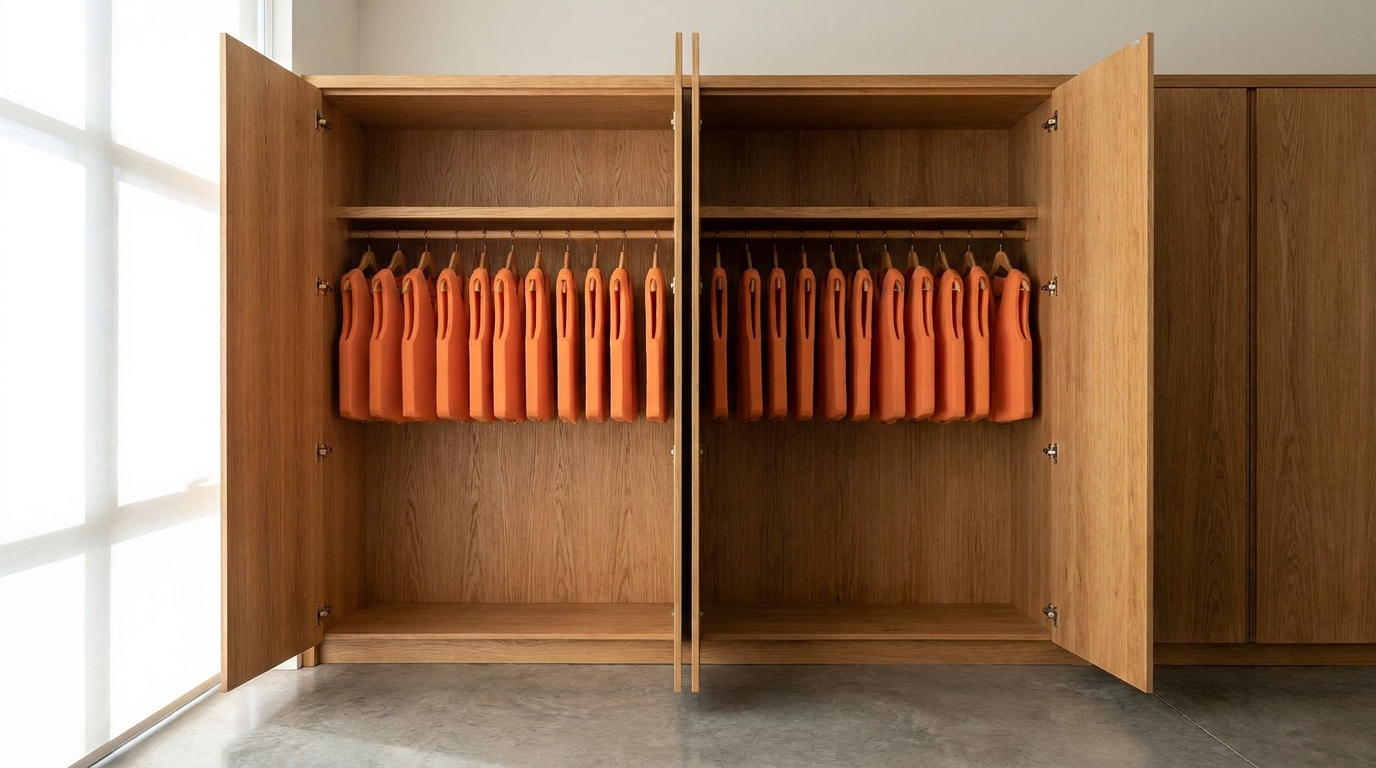
One foam vest, one hook. Hang it from a wide hook so the foam hangs open and the straps hang free. If there is no loop that can carry the weight, lay the vest flat, one layer deep. Stacking "just for winter" is how foam becomes permanently compressed, and that condition is not serviceable [5].
Do not knot or pinch the straps. Webbing that is ripped, torn, or separated from the jacket fails on its own [5]. Buckles stay visible so you can see that they still close.
Inflatables lie flat. Compact is not the same thing as folded under a crate. If the label sends you to a manual, follow that manual [2]. We do not invent a fold the manual never described.
Chambers must be able to hold air [5]. An inflatable must have a full cylinder, and all inflator indicators must be green, or it is not serviceable and does not meet the carriage requirement [7]. The shelf stays open so those indicators are visible.
Throwables are not pads. Do not use a life vest or a throwable cushion as a kneeling pad or a boat fender [9]. The same care page says not to use a throwable cushion as a seat, because that use degrades the foam and reduces flotation [9].
We store cushions flat or on edge, alone, and we hang a ring so it stays round. On the boat, that throwable still has to be immediately available [6].
No sealed bag. Plastic bags are on the do-not-stow list [7]. After a wet ride, the jacket dries in open air, then it goes on the hook [9]. It does not go into a bag with the camping quilts.
5. Match the hook to the label, and to the state line
A sound jacket still fails if it is the wrong size or the approval number cannot be read [4]. The wear page lists broad weight bands: adult, greater than 88 pounds; youth, over 55 pounds and up to 88 pounds; child, over 33 pounds and up to 55 pounds; and infant, 33 pounds or less [7].
The label on the jacket in your hand controls. Worn correctly, a foam jacket fits snugly and does not rise above the chin or ears [7]. A small tag on the hook, copied from that label, keeps a growing child from getting last summer's vest by habit.
Inflatables are a narrower group. They are generally intended for persons over 80 pounds, and the wearer must be over 16 for the jacket to meet carriage requirements [8]. They are not appropriate for weak or non-swimmers [7]. We do not park an inflatable on a child's hook to save space.
Lake Wylie crosses a state line, so one sentence will not cover the wear rules. Under the federal rule, each child under 13 on a vessel underway must wear an appropriate Coast Guard-approved device unless that child is below decks or in an enclosed cabin [2]. If a state sets a different child wear rule, the state rule applies on waters subject to that state [8].
North Carolina. Anyone younger than 13 must wear an appropriate life vest on a recreational vessel that is underway. So must anyone riding a personal watercraft or being towed. A Type I, II, or III device, in good condition and the right size, must be accessible for each person, including on canoes, kayaks, and rowboats [10].
Sailboards, racing shells, rowing sculls, racing canoes, and racing kayaks are exempt on that page. For a child, check the Coast Guard label, match current weight, and keep the fit snug but comfortable [10].
South Carolina. Each person needs a wearable Coast Guard-approved device of the right size, readily accessible, and in serviceable condition. Children under 12 must wear one on a boat less than 16 feet long, proper size and fastened [11].
Anyone operating, riding, or being towed behind a personal watercraft must wear an approved jacket, and inflatables are prohibited for that use and for water skiing or other aquaplaning. Readily accessible means you can put the device on in a reasonable time, not pull it from a plastic bag or a locked compartment [11].
A house in Fort Mill, Rock Hill, or Waxhaw that launches from both shores should store to the stricter habit. Children get a Coast Guard-approved foam vest that fits their weight now. Adult inflatables stay with adults who meet the label, and they do not go on the personal watercraft or the tow rope.
Older tags may still say Type I, II, III, or V. Newer tags talk about performance level. Either way, use the jacket as its own label requires [2].
A serviceable approved jacket can stay. A ruined one does not stay just because an old type code is still printed on it.
6. Inspect in the bay, and replace what fails
Foam, once a year. Foam-filled jackets should be tested for wear and buoyancy at least once a year. Waterlogged, faded, or otherwise damaged devices should be discarded [7]. At the start of the boating season, check hardware, straps, mildew, lumpy or hardened buoyancy material, oil in the fabric, rips, and a readable approval label [9]. You do that in the open bay, not by unpacking a tote in the driveway.
The fail list is specific. Broken or corroded hardware, torn straps, seams open enough to lose buoyant material, and foam that is hard, compressed, waterlogged, oil-soaked, or mildewed all fail the serviceable test [5]. Replace the jacket. Do not sew a shell shut over missing foam, and do not try to fluff a panel that is permanently compressed.
Inflatables, on a shorter clock. Check the inflator every time you use the jacket, so the cartridge is installed and the indicators are green [7] [9]. Every two months, inflate it by mouth, leave it overnight, and replace it if it leaks [9]. Replace a spent gas cartridge right away [9]. Oral tubes, the lanyard, and the indicators are part of the serviceable-condition rule, not optional extras [5].
Clean without fuel or heat. Do not use harsh detergents or gasoline, and do not remove labels, straps, or buckles [9]. Mild soap, a rinse, and open-air drying are the path back to the hook. Direct heat stays off the list [9].
Kids change size faster than foam wears out. Match the vest to current weight before you call the hook ready [7] [10]. If the approval number is no longer legible, the jacket no longer meets the marking rule, even if it still seems to float [4].
Many Lake Wylie households own more jackets than seats. Size the bay to that count, with one hook or one flat slot per jacket. Empty hooks stay empty.
Practical takeaways
- Give life jackets their own dry, ventilated garage bay. Hang foam vests or lay them flat. Do not stack other gear on the foam, and do not store the jackets in the pool-towel closet or on the bike and golf wall.
- Keep every jacket off the floor, out of sealed plastic, and away from direct heat, gasoline, and oil. Dry a wet jacket in open air before it goes back on the hook [5] [9].
- A required device must be serviceable, the size marked on the label, and still showing a legible approval number. Permanently compressed, waterlogged, or mildewed foam does not pass [4] [5].
- On the boat, wearables must be readily accessible and throwables must be immediately available. Garage storage does not replace that stowage [6] [7].
- Plan a wearable for each person. Add a throwable on a recreational vessel 16 feet or more, with the canoe and kayak exception the rule actually states [2] [3].
- On Lake Wylie, follow the state you are boating in. North Carolina's child rule is younger than 13 while underway, plus personal watercraft and towed sports. South Carolina's child rule is under 12 on boats under 16 feet, and it bars inflatables for personal watercraft and skiing [2] [8] [10] [11].
- Check foam jackets at least once a year, and check inflatables more often, including a full cylinder and green indicators. Discard a damaged jacket instead of improvising a repair [5] [7] [9].
How we can help
Have more questions or want to get in touch? We plan garage storage with an open bay for life jackets, off the floor and separate from bike and golf gear. Visit our contact page, call (704) 604-3870, or email design@theclosetrehab.com.
Citations
- U.S. Coast Guard, "Recreational Boating Statistics 2024" (2025-06-24)
- eCFR, "33 CFR 175.15 Personal flotation devices required" (2026-11-12)
- eCFR, "33 CFR 175.17 Exemptions" (2026-11-12)
- eCFR, "33 CFR 175.21 Condition; size and fit; approval marking" (2026-11-12)
- eCFR, "33 CFR 175.23 Serviceable condition" (2026-11-12)
- eCFR, "33 CFR 175.19 Stowage" (2026-11-12)
- U.S. Coast Guard Boating Safety Division, "Life Jacket Wear / Wearing your Life Jacket" (2026-11)
- U.S. Coast Guard Boating Safety Division, "Frequently Asked Questions" (2026-11)
- BoatUS Foundation, "Life Jacket Care" (2026)
- North Carolina Wildlife Resources Commission, "Children Must Wear PFDs" (accessed 2026-11-16)
- South Carolina Department of Natural Resources, "Life Jacket Awareness" (accessed 2026-11-16)