Garage Tool Battery Storage Off the Workbench
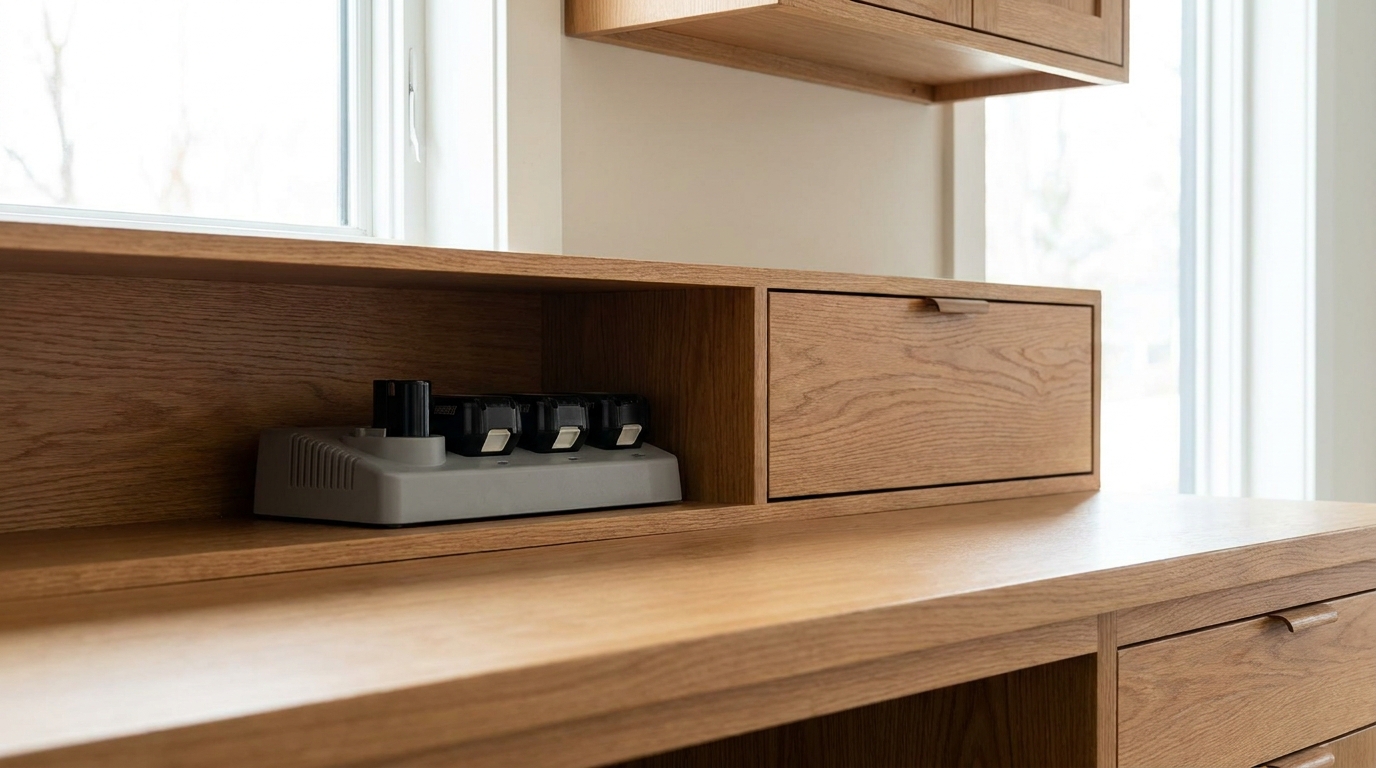
Cordless drill and driver batteries should leave the workbench and sit on a hard, flat dock, with the charger cord stored in a closed locker once charging stops. The National Fire Protection Association's September 2026 Fire Prevention Week guidance says to charge devices on a hard, flat surface such as a table or desk, not on a bed, a couch, or under a pillow, because chargers make heat and soft surfaces can trap that heat and block airflow. [1] The same message says larger batteries, including power tools, should charge outside and away from exits, while the Power Tool Institute says to charge in a dry place and not outdoors, so the manual for that charger is what you follow. [1][8] The dock is still the garage home for the packs and the cord, and it is a different spot from the path the car charger and the driver door need.
1. The workbench is a work surface, not a charging shelf
The problem shows up on a project day. The drill, the driver, the bits, and the charger all land on the same top, and by noon the charger is behind a drop cloth with the cord in the way of the cut.
That top is for the job. A dock is a separate bay for the batteries. The U.S. Fire Administration says charging on a soft surface, or blocking ventilation, raises fire risk, and it says to set devices on a solid, flat surface rather than in direct sunlight. [3] A bench under a moving blanket is no longer that open surface.
The pack should come off the tool when you set the tool down. The Power Tool Institute says to remove the battery, or lock the switch off, when the tool is idle and when you change an accessory, adjust it, or clean it. [8] If the bench is the only flat place, the pack goes right back there. We plan the workbench top for the project itself, and we put charging on a wall bay a short reach away.
2. The tool dock is not the car-charger spot
The car charger cable and the driver door each need room to move. The tool-battery dock is not that path, and it should not borrow it.
Park the dock off both swings. Put it on a side wall, or at the end of a cabinet run, where the driver door does not sweep and where the car's charge cable does not have to cross it. In many Charlotte garages the car sits close to one wall, and that wall only looks free until the door opens.
Keep it off the floor lane. A dock between the bumper and the house door gets kicked, and the cord gets driven over. We mark the door arc and the cable path before we draw the cabinet run, then we put tool charging somewhere else.
3. The charging-location instructions do not match
Do not assume the dock is also the place a pack should charge. Two published instructions point different ways, and the charger manual breaks the tie.
In its September 23, 2026 release, NFPA says to charge larger items like e-bikes, scooters, and power tools outside and away from exits, because those batteries store more energy and a fire can grow quickly if one fails. [1] The same release says NFPA does not yet track data on the number of U.S. home fires involving lithium-ion batteries, so this post does not quote a national fire total. [1]
The Power Tool Institute says to charge in a dry location, not outdoors, and out of direct sunlight, and it says the operator's manual is the best source for that tool. [8] NFPA's 2025 consumer tip sheet says to follow the manufacturer's instructions and to use only the charging cord that came with the device. [2]
If that manual keeps the charger indoors and dry, the dock is the shelf. If the manual allows outdoor charging, follow the 2026 message, then bring the pack and the cord back to the dock when you unplug. [1] Either way, use the charger that came with the device, or one the manufacturer approved. NFPA says the wrong charger can damage the battery and increase the chance of fire. [1]
UL Solutions says to use the manufacturer charger, or one designed for that device, and to choose batteries certified to UL Standards and look for the UL Mark. [6] The Fire Administration says to use original or certified replacement chargers and cables, and it notes that low-quality cords and chargers often lack overcurrent or thermal protection. [3]
Check the temperature before you walk away. The 2025 NFPA sheet says to keep batteries at room temperature when possible, and not to charge them below 32°F (0°C) or above 105°F (40°C). [2] The Fire Administration repeats those limits, and it calls direct sunlight or a hot car a fire risk. [4] A closed garage on a hot afternoon can miss that window, so look before you leave a pack on the dock.
4. Build the shelf so a pack can sit there safely
If the manual allows indoor charging, the dock still has to meet the other rules. Spare packs that only rest there follow the same rules.
- Hard and flat. NFPA names a table, a desk, or another hard, flat surface, not a bed, a couch, or a pillow, because charging makes heat and soft surfaces trap it. [1] Keep rags and pads off that shelf.
- Open to air. Blocking ventilation raises fire risk, and power tools should stay in a dry, ventilated space away from flammable materials and building exits. [3]
- Clear of anything that can burn. Store batteries away from anything that can catch fire, and do not charge near combustible materials. [2][8]
- Out of the exit. Charge larger tool batteries away from exits, and do not store them where they block the way out. [1][3]
- One plug, and no extension cord. Plug only one charging appliance into an outlet, and do not use an extension cord while an appliance is charging. [5]
- Away from children and loose metal. Keep packs and chargers out of children's reach, and away from coins, keys, nails, and screws that can bridge the terminals and cause burns or a fire. [8]
- A heat alarm is separate from the shelf. The Fire Administration says a garage should have a heat alarm, not a smoke alarm, and that it sounds if the temperature rises too high. [5] We do not build that alarm into the cabinet.
5. A damaged pack does not go on the charger
The dock is for packs that still behave normally. It is not a test bench for a bad one.
Take the pack off the charger if it feels very hot, swells, smokes, or smells strange. NFPA calls those signs that the battery may be damaged or failing. [1] The 2025 tip sheet also lists odor, a change in color, too much heat, a change in shape, leaking, and odd noises. [2] If it is safe, move the device away from anything that can catch fire and call 911. [2]
Stop immediately if a battery is smoking, hissing, punctured, or swollen. [3][4] Do not put a dropped pack back on the charger to see if it still takes a charge. The Power Tool Institute says not to use a charger or a pack that has been hit, dropped, or damaged. [8]
UL Solutions describes thermal runaway as a battery heating itself out of control, which can bring extremely high temperatures, smoke, fire, toxic off-gassing, or an explosion. [6] Watch for heat, smoke, or bulging, and call 911 if a fire starts, because these fires can give off toxic gases. [6]
If the pack is already burning, do not try to put it out. Leave and call 911. [9]
A healthy pack still comes off the charger when it is full, because extra time can add heat and stress. [1][2] Unplug a pack that is noticeably hot while it is charging. [9]
6. The cord locker is for the cord, not for a hot pack
Unplug first, then coil the cord into the locker. [1] A cord left on the floor gets pinched under a tire, caught in the driver door, or left as a trip line. If the factory cord cannot reach the receptacle, the dock is in the wrong place, because an extension cord is not the fix while an appliance is charging. [5]
Do not charge inside the locker. Close the door only after the pack is off the charger. Blocking ventilation raises fire risk, and this storage should stay dry and ventilated. [3]
We build the dock as three jobs: an open shelf so the charger sits flat, a slot for each spare pack, and a door for the cord only after you unplug. We place that bay at a receptacle, or we mark a new outlet on the layout, so the listed charger plugs in directly. The workbench keeps its own outlets for the tool in your hand.
7. Match each pack to its own charger
A shared brick turns the dock into a junk shelf. Use each cordless tool only with its recommended packs, and charge those packs only on their recommended chargers, because other packs may create a risk of fire, burns, and explosions. [8]
Label the shelf lip. Write the brand and the voltage where you can read them. When a pack will not seat, it does not belong on that charger. Store spare packs at room temperature when you can, away from anything that can catch fire, and not in direct sun or a hot car. [2][4][8] Where two people share the garage, that label keeps the wrong charger from being an afternoon mistake.
8. A finished pack leaves the house a different way
The dock is for packs you are still using. A pack that will not hold a charge, or that you removed because it is damaged, does not belong in a jar of old alkaline cells.
Do not put lithium-ion batteries, including the packs that lift out of handheld power tools, in household garbage or recycling bins. Take them to a battery recycler, a retailer take-back, or a household hazardous waste site. [7] A battery in the trash or the curbside bin can be crushed and start a fire, and even a used pack can still have enough energy to injure someone or start a fire. [7]
Tape the terminals and bag the pack. Put each battery in its own plastic bag, and cover the terminals with non-conductive tape such as electrical tape. [7] Do not throw a pack into a fire, even when it is damaged or worn out, because it can explode. [8] If the pack is damaged, contact the maker for handling instructions and heed the markings, because not every pack is meant to be opened. [7]
A small labeled bin beside the locker can hold one taped pack until the collection trip. It should not hold packs you still plan to charge.
Practical takeaways
- Keep drill and driver chargers on a hard, open dock, off the workbench and off any soft pad. [1][3]
- Read the charger manual before you choose indoor or outdoor charging. NFPA's 2026 message and the Power Tool Institute do not agree about charging outside. [1][8]
- Do not charge below 32°F or above 105°F, and do not charge in direct sun. [2][4]
- Plug one charging appliance into the outlet, skip the extension cord, and unplug when the pack is full. [1][5]
- Keep the dock off the exit, off the car-charger path, and off the driver-door swing. [1][3]
- Do not charge a pack that is swollen, leaking, smoking, hissing, punctured, or dropped. [1][3][8]
- If a battery is already on fire, leave and call 911. [6][9]
- Put the cord in the locker after you unplug, and do not close a charging pack inside that door. [3]
- Tape the terminals and take finished power-tool packs to a recycler or household hazardous waste site, not the trash or the curbside bin. [7]
How we can help
We plan garage walls for homes in Charlotte, Fort Mill, and nearby towns so the workbench stays a work surface and the tool batteries have their own dock and cord locker. That layout sits with the cabinets, slatwall, and workbench planning on our garage page. Have more questions or want to get in touch? Visit our contact page, call (704) 604-3870, or email design@theclosetrehab.com.
Citations
- National Fire Protection Association, "Fire Prevention Week, Oct. 4-10, focuses on lithium-ion battery charging safety" (2026-09-23)
- National Fire Protection Association, "Lithium-Ion Battery Safety" (2025)
- U.S. Fire Administration, "Lithium-Ion Batteries: Everyday Convenience, Hidden Fire Risks" (2026-10-13)
- U.S. Fire Administration, "Battery Fire Safety" (2026-09-03)
- U.S. Fire Administration, "Basement and Garage Fire Safety" (2026-09-03)
- UL Solutions, "Safety First: UL Solutions Amplifies Awareness for Battery Safety and Fire Prevention" (2025-10-31)
- U.S. Environmental Protection Agency, "Used Lithium-Ion Batteries" (2026-03-20)
- Power Tool Institute, "Cordless Battery Safety" (2025)
- U.S. Fire Administration, "Educating your Community" (2026-09-03)