Kids Sports Gear Storage for Cleats, Jerseys, and Bags
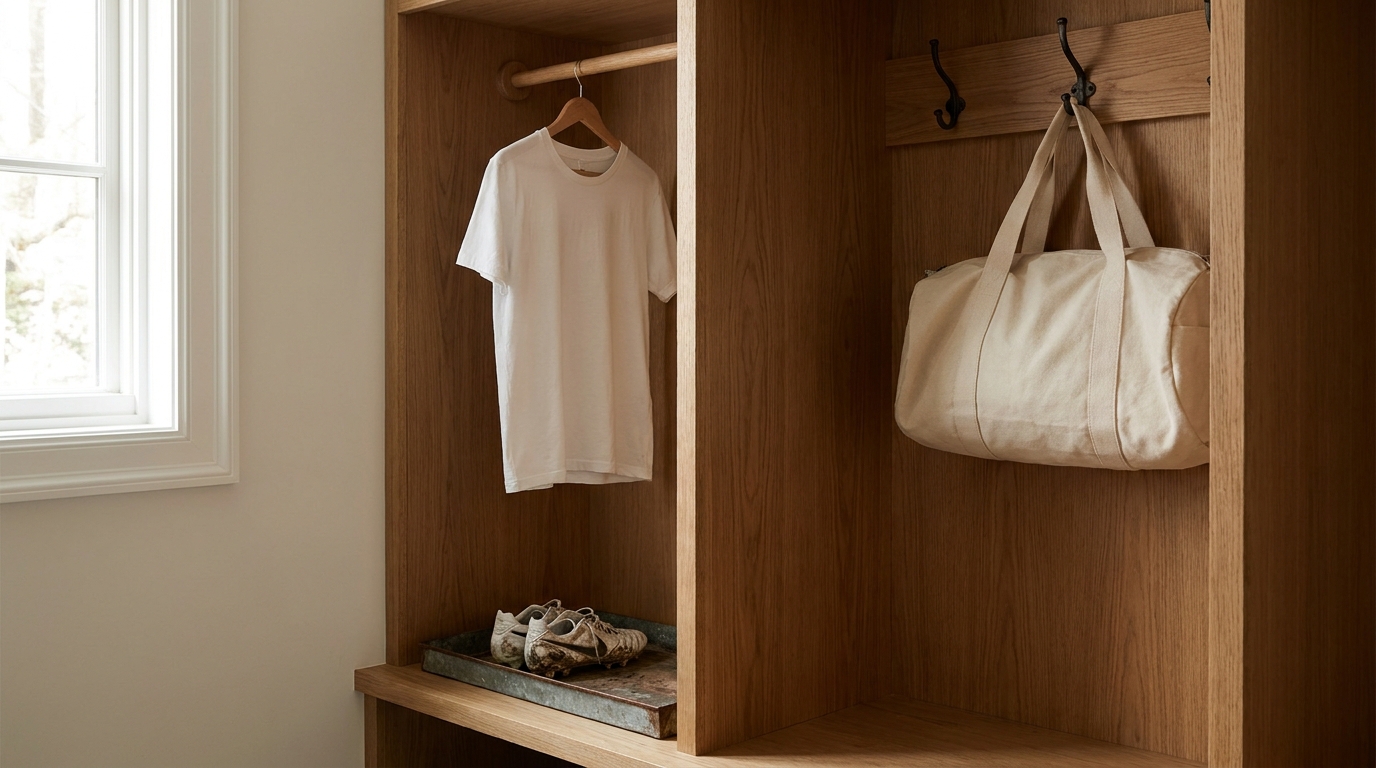
A hall or mudroom cubby is the landing spot for the weeknight practice pile: muddy cleats on a drip surface, the jersey on a short rod or hook, and the gear bag on a hook so it leaves the floor. That bay belongs in the entry, not on the garage bike wall, not in the primary-closet gym-clothes zone, and not at the homework desk. The Centers for Disease Control and Prevention says children and adolescents ages 6 to 17 need 60 minutes or more of moderate-to-vigorous activity each day [1]. A May 2026 Project Play summary of federal survey data put U.S. youth sports participation at 58 percent in 2024 [2].
1. Why the practice pile needs its own bay
Practice ends in the hall, between the car and dinner. Around Charlotte and Fort Mill, the pile looks familiar. Cleats sit by the door, a damp jersey lands on a chair, and a bag never quite gets emptied.
Moisture comes before clutter. The U.S. Environmental Protection Agency says the key to mold control is moisture control, and that damp items should be dried within 24 to 48 hours [3]. A North Dakota State University Extension publication reviewed in 2023 notes that closets often grow mold when clothing is stored damp or dirty, and that mold will grow on a damp surface within a couple days at normal temperatures [4]. A zipped bag in a warm entry works against both points.
The 58 percent figure is a year of play, not a headcount of tonight's games [2]. Project Play traces it to the National Survey of Children's Health. Parents of children ages 6 to 17 were asked whether, during the past 12 months, the child participated in a sports team or took sports lessons after school or on weekends [2].
This bay is not three other projects. Bikes, bats, and ball bins belong on a garage wall. Daily gym clothes belong in a ventilated closet pocket, not with a child's cleats. Homework stays at a desk niche. The cubby only catches what comes home from practice until it is dry, washed, or ready to grab again.
One child, one bay. Two kids on one hook fail by the second night. We give each player a labeled opening, a reachable hook, and a drip spot of their own. A first name or a sport on the label is enough.
2. Wet cleats get a drip spot, not a wood shelf
Cleats come home with mud, dew, and sometimes a puddle in the heel. A finished wood shelf is the wrong place for that water.
Wood and a puddle do not mix. The EPA notes that molds can grow on wood, paper, carpet, and foods when moisture is present [5]. Its home mold guide also says to keep indoor relative humidity below 60 percent when possible, ideally between 30 and 50 percent [3]. A cleat sitting in its own drip keeps the shelf wet. The shelf is a furnishing, not a drain.
Give the water its own surface. We use a removable tray, a metal grate, or a slatted rack over a pan you can wipe or take outside. Cleats rest above the water so air moves under the sole, and the cabinet stays dry because the water stays in the tray.
Knock the mud off outside. A stiff brush by the door is enough after a late practice in Waxhaw or Ballantyne. The big clumps should come off before the pair hits the tray.
Leave the pair open until it is dry. Separate cleats that were stuffed together, and loosen the laces. Set a soaked insole beside the shoe. Plain paper in the toe holds the shape while air moves through. That is a household habit, not a lab result.
Do not nest a wet pair in a closed bin, a plastic bag, or the gear bag.
NDSU Extension says stored clothes should be clean and dry, and that boxed articles will stay wet if they become damp [6]. A sealed bag is that kind of closed container.
Dry cleats can move to an open shelf. Until then they stay on the tray, even if a humid evening is not long enough. Do not stack a second wet pair on top.
The 2023 NDSU review says molds grow on materials such as paper, leather, dirt, and soap scum, and that they grow in moisture [4]. Plenty of current cleats are synthetic, not leather. The dirt in the tread is still dirt, so the wet pair stays out of a closed corner.
3. Jerseys need a short rod and a path to the washer
A jersey is not a coat. It needs a short hang between the car and the laundry, then the same rod once it is clean and dry.
Youth uniforms wick, and they still need air. In a May 2024 article, Iowa State University Extension and Outreach wrote that most sport uniforms are polyester or a cotton and polyester blend, with polyester widely used for youth uniforms [7]. Polyester wicks sweat off the skin, and its downside is oil-based stains plus shrinkage with heat [7]. Spandex in the blend may not take a harsh wash, so read the tag [7]. Air drying is one of the five musts in that article [7].
That is what the short rod is for.
Get the dirty jersey out of the bag the same night. Iowa State also says to get to stains as soon as possible [7]. Blood, sweat, grass, mud, and most dirt are protein stains, and they set in hot water, under an iron, or in a dryer [7]. If you presoak, the article gives cold to lukewarm water, less than 100 degrees F, before an enzyme detergent [7]. Hang the shirt open instead of balling it in the bag until the weekend.
Keep air around the hang. A short rod, or two hooks the child can reach, fits the jersey in use and one clean backup. The 2023 NDSU review says opening closet doors so air can move limits mold growth [4]. Crack the cubby door until the shirt is dry. A solid door is for the side that is already dry.
NDSU also says to store clothing clean and dry, so a jersey that still smells like the field goes to the washer, not into a closed cabinet for the week [6]. After the wash, air dry on that rod so high heat stays off a fabric that can shrink [7].
Name the fiber and the stain before you treat the shirt. Iowa State says stain work starts there, because grass, blood, clay, and a sports drink are not the same job [7]. The cubby only has to keep the shirt easy to find until you do.
4. The bag hangs, and the wet gear comes out of it
The bag takes the floor, and it keeps cleats and a jersey wet if nobody unpacks it.
A hook gets it off the floor. We set a sturdy hook inside the cubby or on the side panel, high enough to clear a bench and low enough for the child. Use it for a bag you have emptied, or one you are about to empty, not as a home for a soaked uniform.
Empty the wet things first. Cleats go to the drip tray. A damp jersey goes on the short rod. A soaked one goes to the laundry. Socks go to the hamper, not back into the shoe. Empty a water bottle so it does not leak overnight. If the bag itself is wet, hang it open and leave it unzipped. NDSU warns that boxed articles stay wet once they are damp [6]. A closed bag does the same thing, so wet cleats do not stay zipped inside it.
A helmet in that bag needs its own spot. The CDC HEADS UP page, updated in July 2025, says there is no concussion-proof helmet, and that a helmet can help protect a child or teen from a serious brain or head injury [8]. It also says the helmet should fit, be well maintained, be age appropriate, be certified for use, and be worn consistently and correctly [8]. We park the shell on a shelf or a hook so cleats do not crush it. The shelf does not replace a proper fit, a well maintained shell, or an age-appropriate helmet [8].
One bag per hook. A second sport gets a second hook or a bin you can see. The bag in use stays on the hook. Once an off-season bag is clean and dry, move it to a higher closet shelf or a garage tote. This bay stays sized for the current week.
5. What belongs in the cubby, and what does not
A useful cubby is small on purpose. If it can hold everything, it will.
Four jobs, and no fifth pile.
- Drip spot: today's cleats, on a tray or grate, never on a wood shelf while wet.
- Short rod or hooks: the jersey that is airing, plus the clean one for next practice.
- Bag hook: one unpacked gear bag, off the floor.
- Small open shelf: a dry bottle, shin guards that are not caked, a helmet, or a cap.
A bench in front lets a child sit and pull cleats without tracking mud through the kitchen. We often build that bench into the same run, with nothing hidden in a dark space underneath.
Leave the other gear in its own zone. Bikes, golf bags, and bulk balls stay on the garage wall. Adult gym clothes stay in the closet pocket built for them. Homework and a laptop stay at the desk niche. Fuels and other garage chemicals never share this bay.
Do not pack wet gear against a cold outside wall. NDSU Extension says closets can favor mold especially on exterior walls, and that a cooler closet can support mold even when the humidity in the house is low [6]. That cooler air usually shows up near the outside wall in winter [6]. The page says to store things off that wall so air can move, and to leave closet doors open in very cold weather [6]. We keep the wet side of a mudroom cabinet open or vented. Closed doors are for gear that is already dry.
If the hall already smells musty, clean up the mold and fix the water source before you add hooks [3].
6. A simple routine after practice
These steps fit the short window between the door and dinner.
At the door.
- Brush big mud off the cleats outside.
- Sit, pull them, and set them on the tray with the laces open.
- Hang a damp jersey, or carry a soaked one to the laundry.
- Empty the bag, then hang it.
- Set a helmet on its shelf, not under the bag.
Same evening. Iowa State says to start on stains soon, and the EPA says to dry damp items within 24 to 48 hours [7][3]. A jersey zipped up until the weekend misses both. If the washer is idle, the shirt still hangs open and goes in with the next load.
After the wash. Air dry when the tag says to. Heat shrinkage is why the May 2024 Iowa State article lists air drying among the musts for sport uniforms [7]. Cleats leave the tray only when they are dry. If they are still damp at bedtime, they stay there.
Once a week. Wipe the tray, shake out the bag, and pull a sour bottle, a lost sock, or a second sport that belongs in a dry tote. The 2023 NDSU review says to store clothing dry and clean if you want to limit mold on clothes [4]. The cubby does not wash the uniform or make a helmet safe. It catches tonight's pile and makes the next grab obvious.
Practical takeaways
- Drip, do not shelve wet cleats. Molds can grow on wood when moisture is present, and damp furnishings should dry within 24 to 48 hours [5][3].
- Hang the jersey in moving air. A 2024 Iowa State article says most youth uniforms are polyester or a blend, that heat can shrink polyester, and that mud, grass, sweat, and blood stains set with hot water or a dryer [7].
- Empty the bag, then hang it. Boxed articles that get damp stay wet, and a zipped wet bag works the same way [6].
- Allow a day or two, not a dark week. EPA guidance is 24 to 48 hours, and a 2023 extension review says mold will grow on a damp surface within a couple days [3][4].
- Keep the bay small. Cleats, a jersey, one bag, and a few dry extras. Bikes, gym clothes, and homework stay in their own zones.
- A helmet gets a shelf, not a promise. The CDC says there is no concussion-proof helmet, and that fit, maintenance, age, certification, and correct wear are what matter [8].
How we can help
We design hall and mudroom cubbies for families who come in from practice with a bag, a jersey, and a pair of cleats, including homes around Charlotte, Fort Mill, and nearby towns. Cubbies, hooks, and a bench are part of the drop zones on our mudroom page. Have more questions or want to get in touch? Visit our contact page, call (704) 604-3870, or email design@theclosetrehab.com.
Citations
- Centers for Disease Control and Prevention, "Child Activity: An Overview" (2025-12-04)
- Aspen Institute Project Play, "U.S. youth sports participation increased to 58% in pursuit of 63% by 2030" (2026-05-05)
- U.S. Environmental Protection Agency, "A Brief Guide to Mold, Moisture and Your Home" (2026-02-18)
- North Dakota State University Extension, "Molds in Your Home" (reviewed 2023-04)
- U.S. Environmental Protection Agency, "What are ten things I need to know about mold?" (2026-09-08)
- North Dakota State University Extension, "Care Required in Closets and Storage Areas to Prevent Mold Growth" (page body undated)
- Iowa State University Extension and Outreach, "Dealing with Sport Stains" (2024-05-14)
- Centers for Disease Control and Prevention, "Safety Guidelines: Helmets" (2025-07-28)