For garage trash cart storage, leave room to park
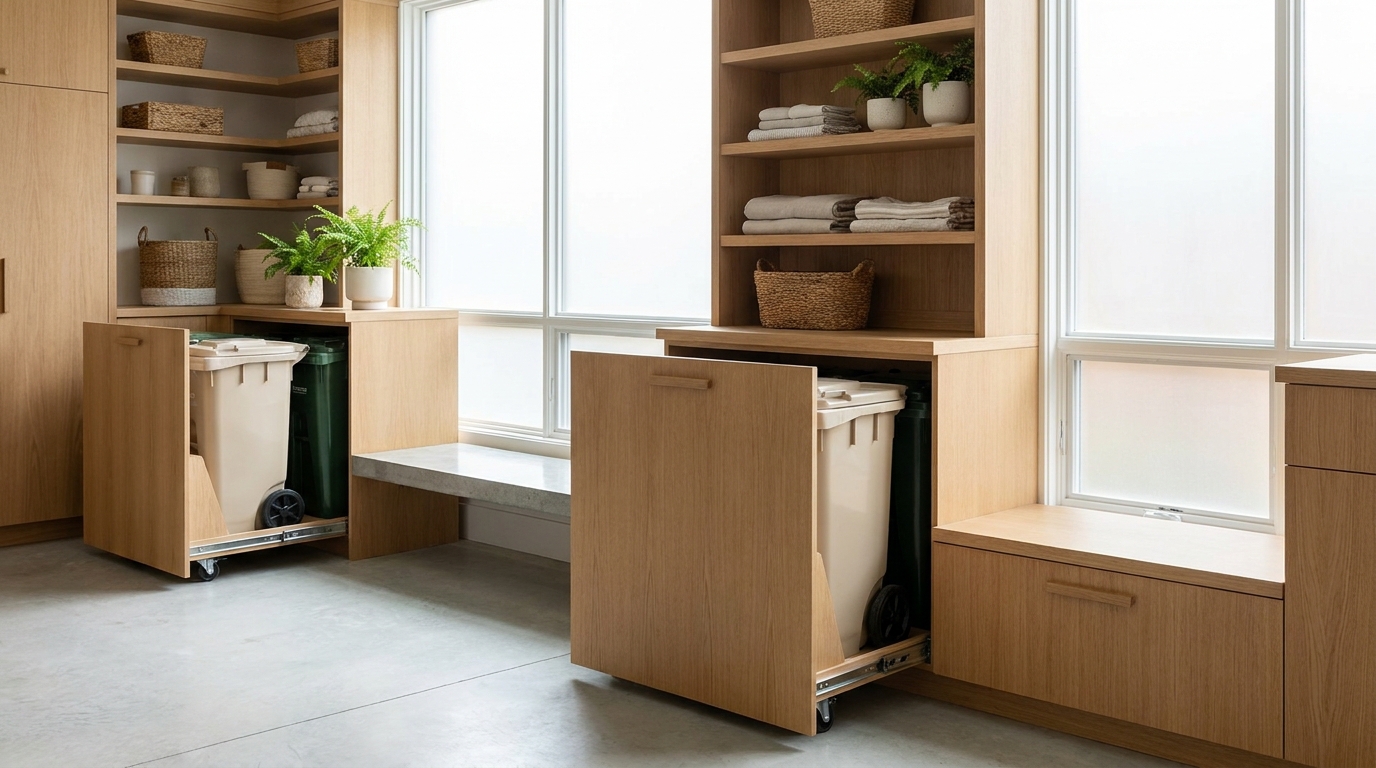
A garage trash cart corral is a short walled bay that holds the wheeled city carts, leaves the lid free to open, and keeps the rest of the stall clear for a car. In Charlotte, household trash has to fit in the gray rollout with the lid closed, and recyclables go loose in the green cart, so a bay that blocks the lid turns into bags on the floor [1][2]. Fort Mill uses its own 95-gallon carts and a different recycling list, so we measure the carts in the garage instead of copying one city's layout across the state line [8].
1. Loose carts eat the stall
Two tall carts with nowhere to stop will claim the driver's door. If a shelf, a bike, or the car blocks the lid, you stop closing it, and what will not fit inside often stays on the floor.
Garage trash cart storage starts with a stop for the carts. A low wall parks each cart off the door swing and leaves the stall for the car.
Many Charlotte households, including homes in Ballantyne inside the city, roll a gray garbage cart and a green recycling cart [1]. Homeowners in Waxhaw, Wesley Chapel, Indian Land, and Rock Hill may have a different count, because rules differ by city and hauler. We count the carts in the garage before we draw a wall.
2. Charlotte only collects what fits with the lid closed
Charlotte collects garbage once a week in the gray rollout [1]. Bag the trash, tie the bags, and keep loose trash out [1][2]. Household trash has to fit inside with the lid closed, and items set beside the cart are not collected [1][2]. Hazardous waste, construction debris, electronics, lithium batteries, and vape pens are not eligible for that cart [2].
Recycling is every other week, on a green week or an orange week, in the city-issued green cart [2]. Place items loose, do not bag them, do not overfill the cart, and cut or tear cardboard into small pieces so the cart can empty [1].
On a Charlotte collection day the cart goes to the curb by 6 a.m., and not earlier than the day before [1]. It comes back by midnight that day [1]. It should sit within 6 feet of the curb, handle facing your property, with 3 feet of space from mailboxes, poles, and vehicles, and it should not block the sidewalk [1].
The lid is the design constraint. If you cannot open the lid inside the bay, bags end up beside the cart, which Charlotte will not take [1][2]. A useful bay lets you open the lid, drop a tied bag or a loose bottle, and close the lid without moving the car.
The city page prints its own recycling list and also points residents to Mecklenburg County's Recycle Right page. On the city list, cardboard cut small, plastic bottles and jugs with necks, paper, milk and juice cartons, glass bottles and jars, and empty metal cans are acceptable [1]. Food, plastic bags, cups, takeout containers, and Styrofoam are not [1].
The county page says it now accepts more plastics, including some takeout containers, cups, and produce clamshells [3]. Where those lists disagree, leave the item out until you confirm it with the program that picks up your street.
3. The county processes the load. It does not roll your cart.
Mecklenburg County does not collect curbside trash or recycling. Charlotte or one of the towns does, and unincorporated addresses contract a hauler [4]. The county processes material at its recovery facility and asks residents to follow one "what goes in" list. It also says its town notes may be out of date, so check the local site [4].
Unacceptable items can contaminate recyclables and make whole loads unacceptable to the buyers of the sorted material [4]. The U.S. Environmental Protection Agency says the wrong items can damage sorting equipment and then have to be landfilled, which raises costs [5]. A resin code does not mean your program takes that plastic, and plastic bags and wrap generally stay out of the curbside cart [5].
EPA treats paints, solvents, pesticides, oil filters, and many batteries as household hazardous waste, not as ordinary trash or recycling. Some of those products can catch fire, react, or corrode [5].
Label the two spots. Do not bag recyclables, and do not put rechargeable or lithium-ion batteries in either cart [3]. Take those batteries to a staffed or full-service center [3].
4. Fort Mill runs a different pair of carts
Fort Mill collects household garbage in a 95-gallon roll cart once a week and recycling in a 95-gallon roll cart every two weeks [8]. Trash bags have to go inside the can, and the lid has to close, so trash does not fall out when the can is lifted [7].
Glass is not accepted in the Fort Mill recycling cart. Broken glass can contaminate the load, and the recovery facility can reject the entire load [8]. Plastic bags, antifreeze, batteries, paint, propane tanks, electronics, and yard debris stay out of that cart [8]. Monitors, televisions, and printers may not go in the trash cart or the recycle cart, and cardboard left at the curb is not recycled [7].
Do not export a Charlotte bay across the line. Charlotte's written list includes glass bottles and jars [1]. Fort Mill's FAQ says glass stays out of the cart [8].
Homeowners in Indian Land and Rock Hill should read their own hauler's page before a layout gets locked. Charlotte's 6 a.m. curb time and Fort Mill's 95-gallon pair are not a regional standard [1][8].
5. A corral is not a kitchen pull-out
This is not a pantry recycling pull-out. A city cart is a wheeled container you roll to the street. The lid is large, the handle sticks out, and the wheels need a clear roll, not a cabinet slide.
Build for the cart you were issued. On an in-home visit, our team measures the garage and the carts with the lids opened the way you load them. Those steps are on our how it works page.
Charlotte's pages describe a gray cart and a green cart without a gallon size, while Fort Mill states 95 gallons [1][8]. We do not guess a universal inch count. Sit the bay beside cabinetry if you want, but do not make it a closed cupboard. You need to see the rim, reach the lid, and pull the cart straight out.
Solid sides keep the cart off the car, and an open front keeps the roll honest. Our garage storage work plans the bay next to a clear stall, not in place of one.
6. Leave a stall, a lid arc, and a roll path
Start with the car. If two vehicles park inside, put the corral on a side wall or in a back corner, outside both door swings. If one stall is already storage, do not fill the last stall with carts.
Check three clearances in the garage you have.
- Lid arc. Open the lid fully. If a shelf, the door track, or a hanging bike hits it, move that thing. A shelf above the cart has to clear the open lid.
- Roll path. Pull the cart to the garage door without lifting it over a step or a pile of shoes. On a Charlotte day the target is the curb by 6 a.m., and the cart should be back by midnight [1].
- Body clearance. You need room to stand at the cart and drop a bag without pinning yourself against the car.
Keep the bay for carts.
- In Charlotte, keep the gray cart and the green cart in fixed spots, and leave side room so a wheel can turn out [1].
- Do not park loose cardboard on the recycling cart. Items outside the cart are not collected, and cardboard that is not cut small can keep the cart from emptying [1].
- In Charlotte, leaves and grass go in paper bags or in containers no larger than 32 gallons, and plastic bags are not accepted for that set-out [1].
A partial wall stops a roll into the car and still lets the lid travel.
7. Keep fuel and chemicals out of the cart bay
A trash cart is not a hazardous-waste locker. Charlotte will not take hazardous waste, construction debris, or electronics in the garbage cart, and it names lithium batteries and vape pens [2]. Mecklenburg says rechargeable and lithium-ion batteries stay out of both carts [3]. EPA's examples of household hazardous waste include paints, solvents, pesticides, oil filters, and batteries [5].
The U.S. Fire Administration says garage fires tend to spread farther and cause more injuries and dollar loss than fires that start in other areas of the home, based on the National Fire Incident Reporting System [6]. It tells you to store oil, gasoline, paints, propane, and varnishes in a shed away from the house, and to keep things that can burn away from appliances [6].
The corral stays boring on purpose. No gas cans, propane, or paint on the cart walls [6]. No battery pile waiting for a later drop-off [2][3]. No hot ash or shop solvents in the trash cart [2].
Keep the bay off a water heater or furnace. If the only free wall is the appliance wall, move the carts.
8. Make collection morning a straight roll
The night before a Charlotte pickup, the carts should already be closed. In the morning, roll them out, set the handle toward your property, leave 3 feet from the car and the mailbox, and bring them home by midnight [1]. In Fort Mill, if the lid will not close, the can is not ready to be lifted [7].
A short rhythm keeps the stall usable.
- Close it when you load it. Overflow beside the cart is not collected in Charlotte [1].
- Bring them back into an empty bay. Charlotte wants the cart off the curb by midnight on collection day [1].
- Keep the streams apart. Bagged trash stays in the garbage cart. Loose, empty recyclables stay in the recycling cart [1][3].
Practical takeaways
- For garage trash cart storage, measure the carts with the lids fully open. Do not size this bay like a small under-counter bin.
- In Charlotte, plan on a weekly gray garbage cart and an every-other-week green recycling cart, both able to close, with a path to the curb by 6 a.m. on collection day [1][2].
- In Fort Mill, plan on two 95-gallon carts, a lid that can close, and no glass in the recycling cart [7][8].
- Keep trash and recycling in fixed spots so bags, film, and batteries do not land in the wrong cart [3][5].
- Put the corral on a side wall or back corner, outside the car door swing.
- Do not store gasoline, paint, propane, or lithium batteries in the cart bay [2][5][6].
- In Waxhaw, Wesley Chapel, Indian Land, or Rock Hill, confirm your hauler's rules before you build. Charlotte and Fort Mill already show how far those rules can differ [1][8].
How we can help
Have more questions or want to get in touch? Our team can plan a cart corral as part of a custom garage. Reach us on our contact page, call (704) 604-3870, or email design@theclosetrehab.com.
Citations
- City of Charlotte, "Collection Guidelines" (2026)
- City of Charlotte, "Solid Waste Service FAQs" (2026)
- Mecklenburg County Solid Waste and Recycling, "Recycle Right Curbside Pickup" (2026-10-02)
- Mecklenburg County Solid Waste and Recycling, "Municipal Curbside Collection" (2026-10-02)
- U.S. Environmental Protection Agency, "Frequent Questions on Recycling" (2026-01-22)
- U.S. Fire Administration, "Basement and Garage Fire Safety" (2026-09-03)
- Town of Fort Mill, "Curbside Pickup" (2026)
- Town of Fort Mill, "Frequently Asked Questions" (2026)