Garage Entry Storage: Hooks and a Bench at the Door
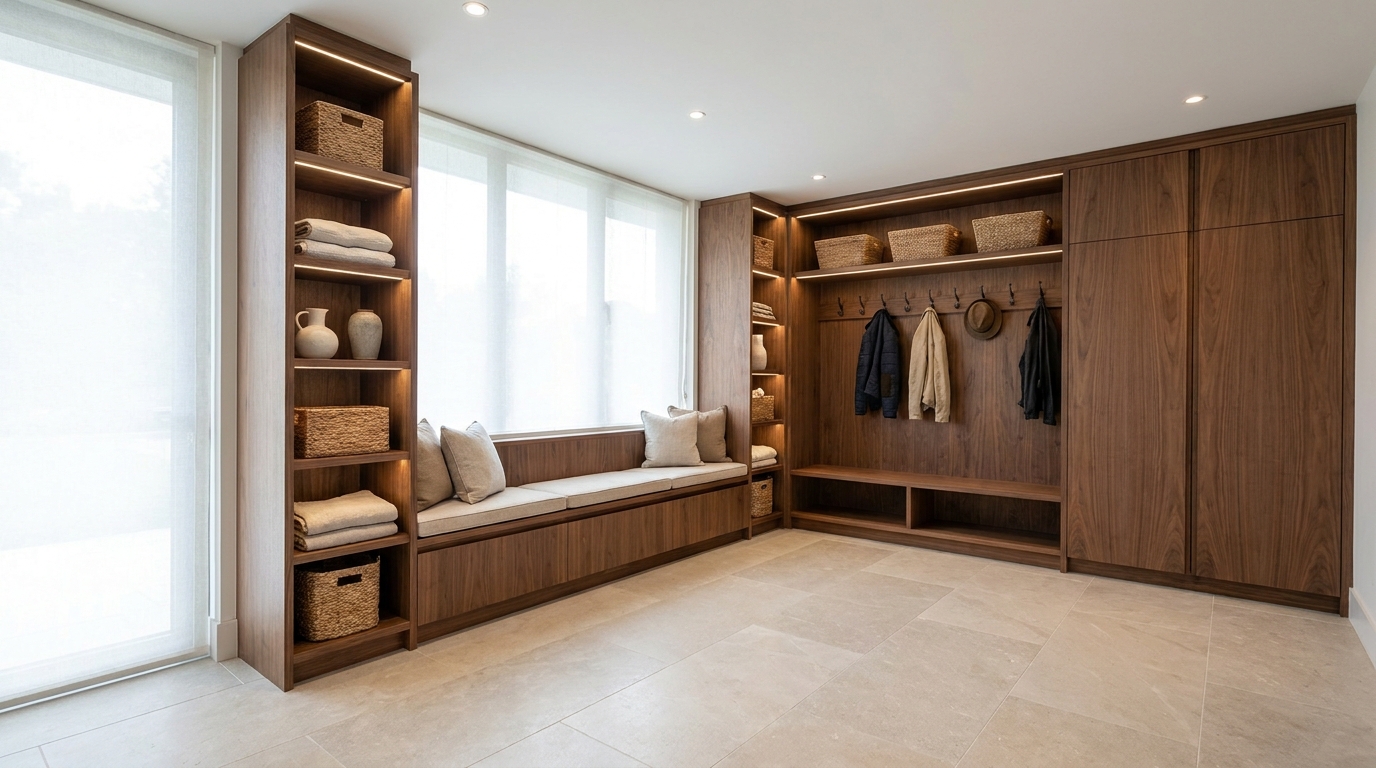
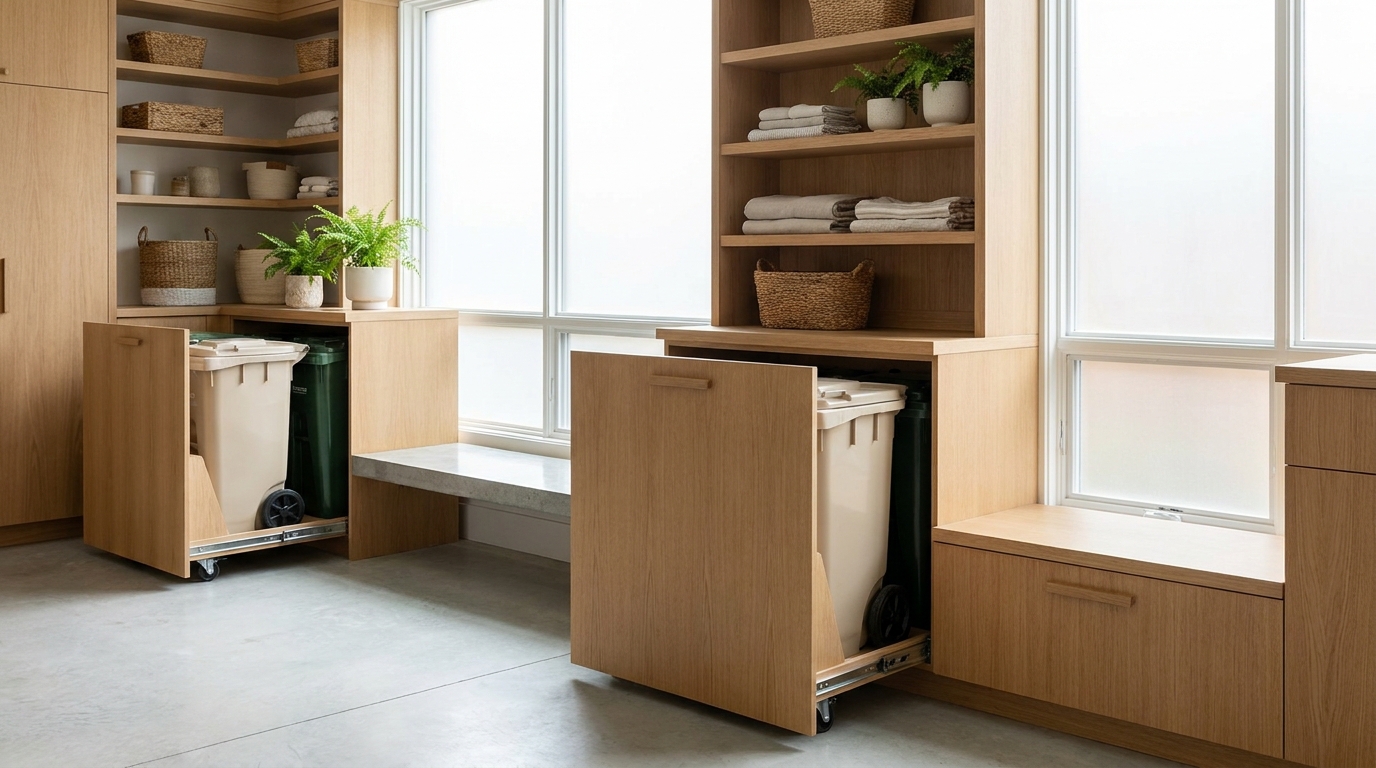
Garage entry storage works best as a shallow landing at the door between the garage and the house: a few hooks people can reach, a short bench that leaves the door free to open and shut, and a boot tray or mat that can dry. It is not a front-foyer locker bank, and it is not a full mudroom of cubbies. University of Georgia Cooperative Extension, in a housing circular last revised in December 2025, says around 30 to 40 percent of the contaminants inside a home are brought in from outdoors, and that the greatest concentration of household dust is found in carpeting near the entryway.[1] The circular's references include a 1991 study of street and house dust, so treat that share as a long-standing estimate, not a new count of local houses.
1. Put the drop zone at the door you use
The front door can stay neat while the garage door takes the real traffic. In Charlotte, and in nearby places such as Fort Mill, Rock Hill, Ballantyne, Waxhaw, Wesley Chapel, and Indian Land, people come in with keys, a backpack, a grocery bag, and shoes that picked up rain, pollen, or red clay. Those items land on the nearest flat spot, which is often the floor.
A shallow drop zone stops that traffic before it walks farther in. University of Georgia Extension says every step inside brings in debris on shoes and clothing, and that pets can track contaminants in as well.[1] The circular says to remove outdoor shoes at the door, keep them out of the way, and store indoor shoes nearby.[1]
Build the landing, not a second room. One hook rail, one short bench, and one tray on the wall beside this door are enough for a weekday. A full mudroom is a different project, covered on our mudroom drop zones page. This article stays on the garage door.
Catch dirt in a short sequence. The circular describes a hard walkway, a scraper-style mat outside, and an absorbent mat inside that holds soil and water below shoe level and has a nonslip back.[1] Its illustrated full run is more than 20 feet, which will not fit here.[1] Use a shorter version: a stiff scraper on the garage side if the floor allows it, then one indoor mat and a boot tray, clear of the path from the car.
2. Keep the path and the door swing clear
University of Georgia Extension's clutter guide, revised in December 2025, says falls and injuries may occur when a person cannot reach things or has to maneuver around piles of stuff, and that this can be a major problem for older adults and people with limited mobility.[2] The guide counts shoes and clothing as clutter when they are left lying around.[2]
The door has a job that storage should not cancel. The U.S. Fire Administration, on a garage fire page last reviewed in 2023, says garage fires tend to spread farther and cause more injuries and dollar loss than fires that start in all other areas of the home, citing the National Fire Incident Reporting System.[3] That page tells homeowners to install a 20-minute fire-rated door that is self-closing and self-latching from the garage into the house.[3] That is guidance for the opening, not proof that every older house nearby already has a closer.
Mark the swing before you build. Tape the door's arc on the floor. The bench, the tray, and any basket sit outside that arc, and the latch should still catch. A basket used as a doorstop works against the door USFA describes.[3]
Leave a clear lane from the car. People come through with both hands full. A bench that forces a sideways step makes people maneuver around it, and the clutter guide warns that maneuvering around piles may lead to falls.[2] USFA says to keep items that can burn on shelves away from appliances.[3] Keep coats off a water heater. A loose rug with curled edges does not belong in that lane.
3. Hang hooks where a hand can reach them
Coats on a kitchen chair show up when the hook is missing or awkward. The clutter guide uses a 60-second rule: if putting something away takes no longer than 60 seconds, put it away instead of setting it down for later.[2] Hooks at this door make that rule possible for a coat, a bag, and a leash.
There is no single hook height for every household, and this article will not invent one. Put the main rail where the adults here can hang a coat without a stool. If a child hangs a backpack, add a lower hook that child can reach. A rail only a tall adult can use becomes a floor pile.
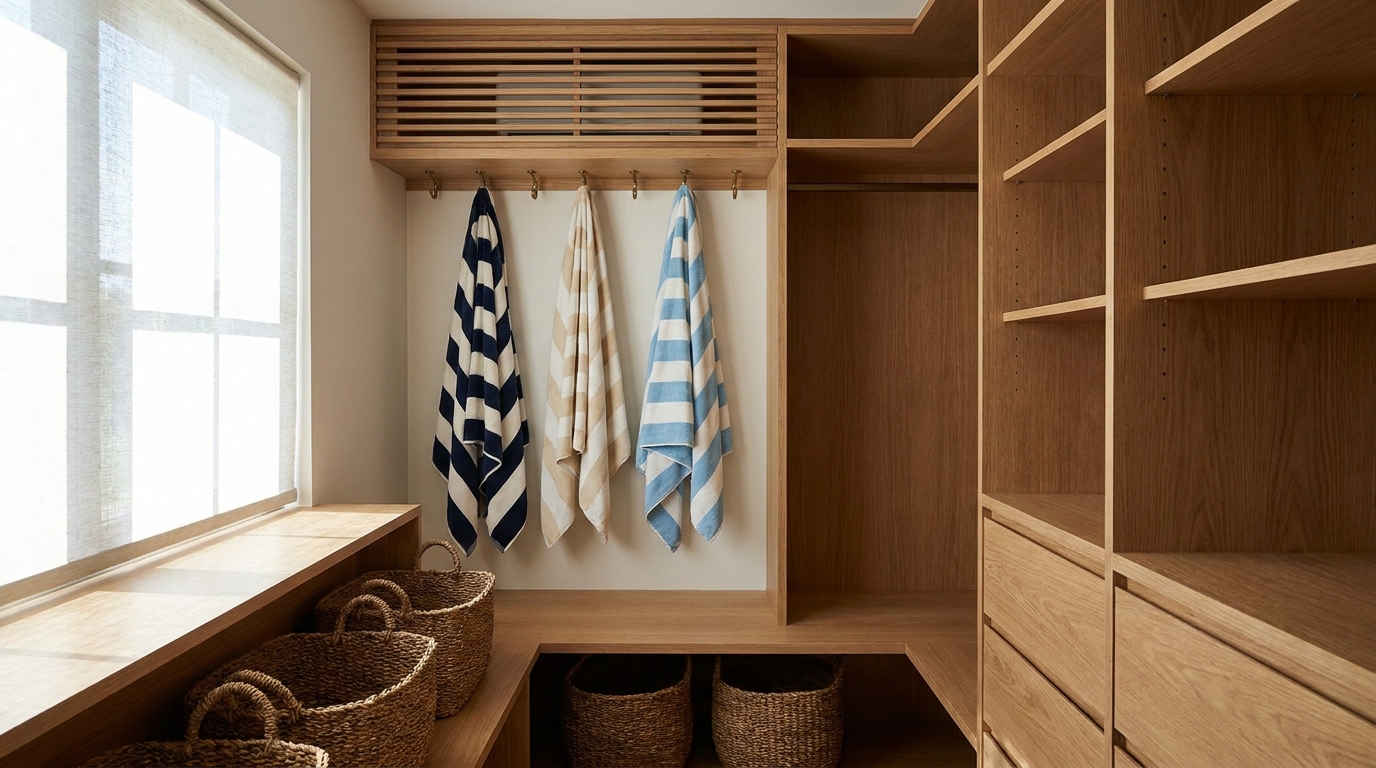
Hang the daily set only. One hook per person for the coat in season, plus one for tomorrow's bag, is enough. Keys and a leash can share a small hook. If the bench sits under the hooks, leave room so a jacket does not cover the seat. Sports gear and a tool wall belong in the wider garage, covered on our garage storage page.
Do not set a tall loose shelf under the rail. University of Georgia Extension's childproofing checklist, revised in October 2025, says to secure unstable or top-heavy furniture with brackets, braces, or wall straps.[6] A hook rail fastened into studs is not that piece. A freestanding shelf a child can climb is a different risk.
4. Add a short bench, not a locker wall
The bench is for sitting, pulling off a wet shoe, and standing back up. Keep it shallow enough that someone with a grocery bag can pass. One open shelf can hold the shoes in rotation. A stack of cubbies for every pair is a closet, not a landing.
Fasten the bench, and anchor anything tall. A bench screwed to the studs is steadier than a hall tree that rocks when someone sits. In the living-room part of that checklist, the advice is to secure unstable or top-heavy furniture to the wall.[6] A low bench is a different piece. If a hutch or cabinet rises above the seat, secure that tall piece the same way.[6] Keep heavier shoes on the low shelf.
Test it against the door. Sit, then open the door through its full swing. Knees, the bench end, and the tray have to clear, and the latch has to catch when the door closes. If you must shove the bench sideways for the door to shut, move it to the adjacent wall, outside the arc.
Keep chemicals off this landing. The checklist says pesticides, automotive products, refinishing products, and paint in a garage belong in locked cabinets or out of reach.[6]
5. Give wet shoes a tray that can dry
Wet shoes on a bare floor track water down the hall. A tray that holds a puddle, or a rug that stays damp, trades one mess for another. EPA's homeowner guide to mold says moisture control is the key to mold control, and that if wet or damp materials are dried within 24 to 48 hours after a leak or spill, in most cases mold will not grow.[4] The guide says to keep indoor humidity below 60 percent if possible, ideally between 30 and 50 percent.[4]
An EPA indoor-air page updated in August 2026 says standing water, water-damaged materials, or wet surfaces serve as a breeding ground for molds, mildews, bacteria, and insects, and that some biological contaminants can trigger allergic reactions, including some types of asthma.[5] It also notes that bacteria are carried by people, animals, and soil and plant debris.[5]
Hold water below the shoe, then dump it. The circular wants soil and water stored below shoe level.[1] A ribbed tray, a slatted insert, or smooth stones lets water drop away from the sole. Empty the tray on a wet week so it does not become the standing water EPA describes.[5]
Skip wall-to-wall carpet here. EPA's mold list says not to install carpeting where moisture is a perpetual problem. The examples include drinking fountains, classroom sinks, and concrete floors with leaks or frequent condensation.[7] Molds can grow on wood, paper, carpet, and foods when moisture is present, and damp furnishings should be dried within 24 to 48 hours.[7] The homeowner guide adds that carpet may have to be thrown away if it becomes moldy, because mold can fill porous materials.[4] Use a hard floor, a tray you can dump, and a mat you can lift and dry.
Air the shoes, then switch to indoor shoes. A closed bin is a poor first stop for shoes just in from the rain. If the mat is still wet the next day, wash it or hang it up.[4] The extension circular says to choose an indoor shoe, slipper, or sock with a nonslip sole, and a hard-soled shoe with traction if someone has balance trouble.[1] Make that swap on the bench, then move dry pairs that are not for tomorrow off the landing.
6. Decide what this landing holds, and stop there
A shallow zone fails when it tries to hold the whole house. The clutter guide says everyone in the home has to pick up after themselves, and that a little straightening every day can save a full do-over later.[2] Its one-in, one-out rule is simple: when an item comes in, another item leaves.[2] At this door, that means a dry pair moves to a closet when the tray is full.
Keep a short list. Coats in use, tomorrow's bag, keys, a leash, and this week's shoes belong here. Every sneaker, guest linens, and paint cans do not. Pet hair, dust, pollen, and mold spores on piles of clutter can trigger asthma and other respiratory concerns.[2]
Measure this door. Our team checks the swing, the walk from the car, and who must reach the hooks during the in-home visit on our how it works page. A bench sized for a wide foyer can block a narrow hall. Overhead racks and a workbench belong in the wider garage plan, not on this landing.
Practical takeaways
- Use the garage-to-house door if that is the door the family actually uses, and keep the zone shallow.
- Mark the door swing and keep the bench, tray, and baskets outside that arc so the door can close and latch.[3]
- Hang hooks people will use, with a lower hook if a child hangs a backpack, and keep only the daily coat and bag on them.[2]
- Fasten a short bench to the wall, and anchor any tall or top-heavy cabinet added above it.[6]
- Dry wet shoes within a day or two on a tray or mat that holds water below the sole, then empty the tray so it does not sit as standing water.[4][5]
- Skip wall-to-wall carpet on a landing that stays wet, and use a hard floor plus a mat with a nonslip back.[1][7]
- Stop when the daily set fits. This landing is not a locker bank, a cubby wall, or a place for paint and automotive products.[6]
How we can help
Have more questions or want to get in touch? Visit our contact page, call (704) 604-3870, or email design@theclosetrehab.com. Our team can measure the garage-to-house door and plan a shallow drop zone for the landing you have.
Citations
- University of Georgia Cooperative Extension, "Reduce Indoor Contaminants: Leave Your Shoes at the Door" (2025-12-04)
- University of Georgia Cooperative Extension, "Household Clutter Control" (2025-12-05)
- U.S. Fire Administration, "Basement and Garage Fire Safety" (2023-04-01)
- U.S. Environmental Protection Agency, "A Brief Guide to Mold, Moisture and Your Home" (2026-02-18)
- U.S. Environmental Protection Agency, "What are biological pollutants, how do they affect indoor air quality?" (2026-08-17)
- University of Georgia Cooperative Extension, "Childproofing Your Home: A Room-by-Room Safety Checklist" (2025-10-10)
- U.S. Environmental Protection Agency, "What are ten things I need to know about mold?" (2026-09-08)