Sheet Pan Storage: Vertical Bays That Clear the Counter
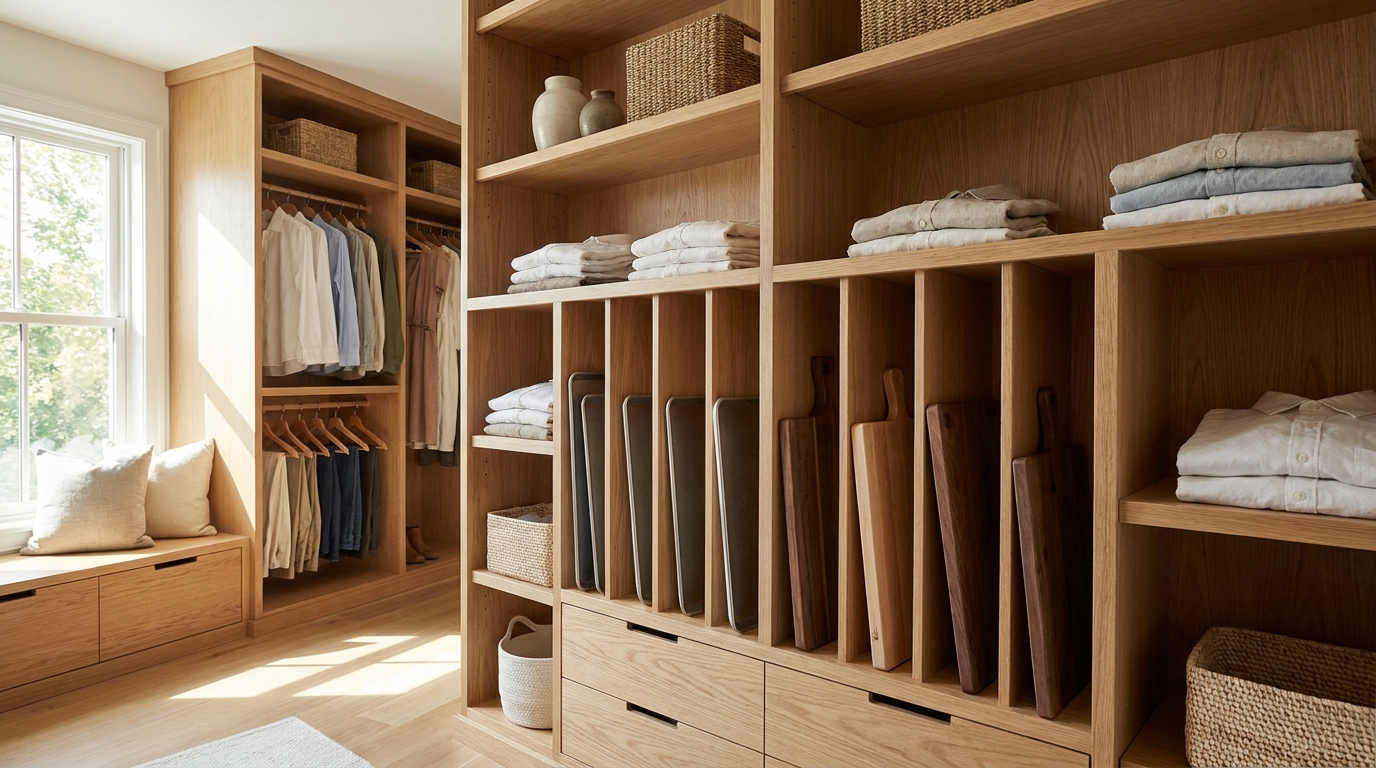
Sheet pan storage, along with cutting boards and serving platters, belongs on edge in a narrow vertical bay beside the range or inside the pantry, not in a pile on the counter. University of Maine Extension says to store cutting boards upright, with air around them, and not to stack wet boards or leave them flat for long periods, because trapped moisture can lead to microorganisms or mold [1]. A real slot for each flat piece makes that habit easy, and it keeps the raw-meat board apart from the produce board [4] and from the bread board [2].
1. The counter fills up because flat things have nowhere to stand
The pile is the problem, not the number of pans. Sheets go in flat, boards go on top, and a platter slides in sideways. The next time you need the rimmed pan, you lift three things onto the counter, and one of them does not go back.
That counter is a surface you are supposed to wash. FDA's safe food handling page, updated in March 2024, says to wash cutting boards, dishes, utensils, and countertops with hot, soapy water after you prepare each food [4]. A counter that is already holding the pans is the surface you are least likely to wipe.
A flat stack also hides a board you should have retired. A grooved board at the bottom still looks fine from the top, so it gets used for salad. University of Maine Extension says to replace boards with deep grooves, cracks, or heavy wear once they cannot be cleaned well, because damaged surfaces may trap bacteria [1]. The Academy of Nutrition and Dietetics, on a page reviewed September 3, 2026, says those grooves can hold bacteria that washing will not remove [2].
2. A vertical bay is a file, not a leftover gap
Stand the piece on edge so one face stays visible. A vertical bay is a narrow run of dividers, and each slot holds one flat piece or a matched pair. You should see the rim, the board color, or the platter edge before you pull.
We do not publish a universal slot width, because a half-sheet, a cookie sheet, and an end-grain board are not the same thickness. Measure what you use. The opening has to clear the tallest piece with room for your fingers, and the depth has to let it stand when the door shuts. If it has to lean hard to fit, it does not belong there.
Keep the bay for flat pieces only. Sheet pans, cutting boards, cooling racks, and platters share a shape. A stockpot or a lid blocks the file, and a warped tray should be retired rather than designed around.
Leave air where a board will live. Maine's bulletin says to store boards upright, ideally where air can circulate, and not to stack them so moisture is trapped between faces [1]. Two thin aluminum sheets can share a slot if they are the same job and still slide free. A wooden board should not be pressed face-to-face against the next board.
3. Sheet pan storage works when each pan has a face you can see
Sort pans by the job, then give each job a slot. Rimmed roasting sheets sit together, and flat cookie sheets sit together. The pan you need on a weeknight should be the first one your hand finds.
Wash the pan before it goes home if it held raw meat. FDA says not to place cooked food on a plate that previously held raw meat, poultry, seafood, or eggs unless that plate has been washed in hot, soapy water [4]. If a sheet held raw chicken, wash it before it holds rolls or the next night's vegetables.
Wash the pan, not the bird. FDA's Food Safety at Home page, updated in October 2023, says not to wash meat, poultry, fish, or eggs, because splashing water can spread bacteria around the sink [5].
Put pans away dry, and keep the working set small. A damp sheet against a wooden board keeps that board wet. Maine says not to use a wet cutting board, because moisture can promote bacteria, mold, and mildew, and to dry the board before you use it again or store it [1].
Wipe the sheet, let it cool, and then file it. Give a coated sheet its own slot so another rim does not grind the cooking face.
4. Cutting boards need a job, a wash, and air on both faces
Give raw meat its own board, and label the slot. FDA's safe food handling page says to use one cutting board for fresh produce and a separate one for raw meat, poultry, and seafood [4]. The Academy says one board should be strictly for raw meat, poultry, and seafood, and the other for ready-to-eat foods such as breads and vegetables, with different colors so nobody has to guess [2].
University of Maine Extension draws the same line and puts fruit, vegetables, and bread on the ready-to-eat board [1]. FDA's home page says to use a special cutting board or plate for raw foods only [5]. Write the job on the divider.
Wash after every use, then sanitize after raw animal food. The Academy says to clean the board in hot, soapy water after each use, then rinse and air-dry or pat dry with a clean paper towel [2]. To sanitize, that page says to flood the board with a fresh mix of 1 tablespoon of unscented liquid chlorine bleach per gallon of water, leave it for several minutes, then rinse and dry [2]. A University of California handout revised in April 2022 gives the same tablespoon-per-gallon step, credits it to USDA guidance, and says to rinse and air-dry or pat dry [3].
Wood gets a shorter contact time, not a soak. University of Maine Extension says not to soak a wooden board, because extra moisture can warp or crack it, and to dry it at once with a clean towel [1]. Its 2025 bulletin offers 1/2 teaspoon of unscented liquid chlorine bleach per quart of water, left on for 1 minute, or, for an occasional deeper clean, 1/2 tablespoon of unscented bleach per gallon with a soak of no more than 2 minutes, then a rinse and a full dry [1].
Use the shorter wood steps above when the board is wood. Use the 1 tablespoon per gallon flood when you are following the Academy and California method [2][3].
Put the nonporous board in the raw-meat slot. Maine notes that nonporous boards are easier to clean and less likely to absorb bacteria, so they are a practical choice for raw animal products, while wood is well suited to vegetables, fruit, and bread [1]. The Academy warns that juices from raw meat, or germs from an unclean object, can reach ready-to-eat food if the boards get mixed [2].
Replace a scarred face before you size the slot. The California handout says to start with a hard, smooth board, such as plastic, marble, glass, bamboo, or wood, and not one that already has deep cut marks where bacteria can grow [3]. Size the slot for the replacement. A sharp knife also lowers the chance of those deep cuts [1].
Dry the board on edge, then oil the wood. Stand it so air reaches both faces, in a dry, clean spot away from food debris [1]. Rub food-safe mineral oil or beeswax into the wood about once a month, and skip olive oil and vegetable oil, which can turn sticky and rancid [1].
Plastic, glass, and nonporous acrylic boards can go in the dishwasher, but laminated boards may crack and split [2]. Some solid wood warps in a dishwasher, and inlays or glued slabs can separate, so follow the maker's card [1].
5. Platters can share the bay if they stand, not lean
Heavy pieces have to stand nearly vertical. A steep lean is how a platter walks forward when the door opens. If it is taller than the opening, give it a shelf with a stop instead of forcing an angle.
Wash and dry a platter before it goes in. Maine says to keep boards away from food debris [1]. A greasy platter in the same cabinet works against that.
6. Put the bay beside the range or inside the pantry
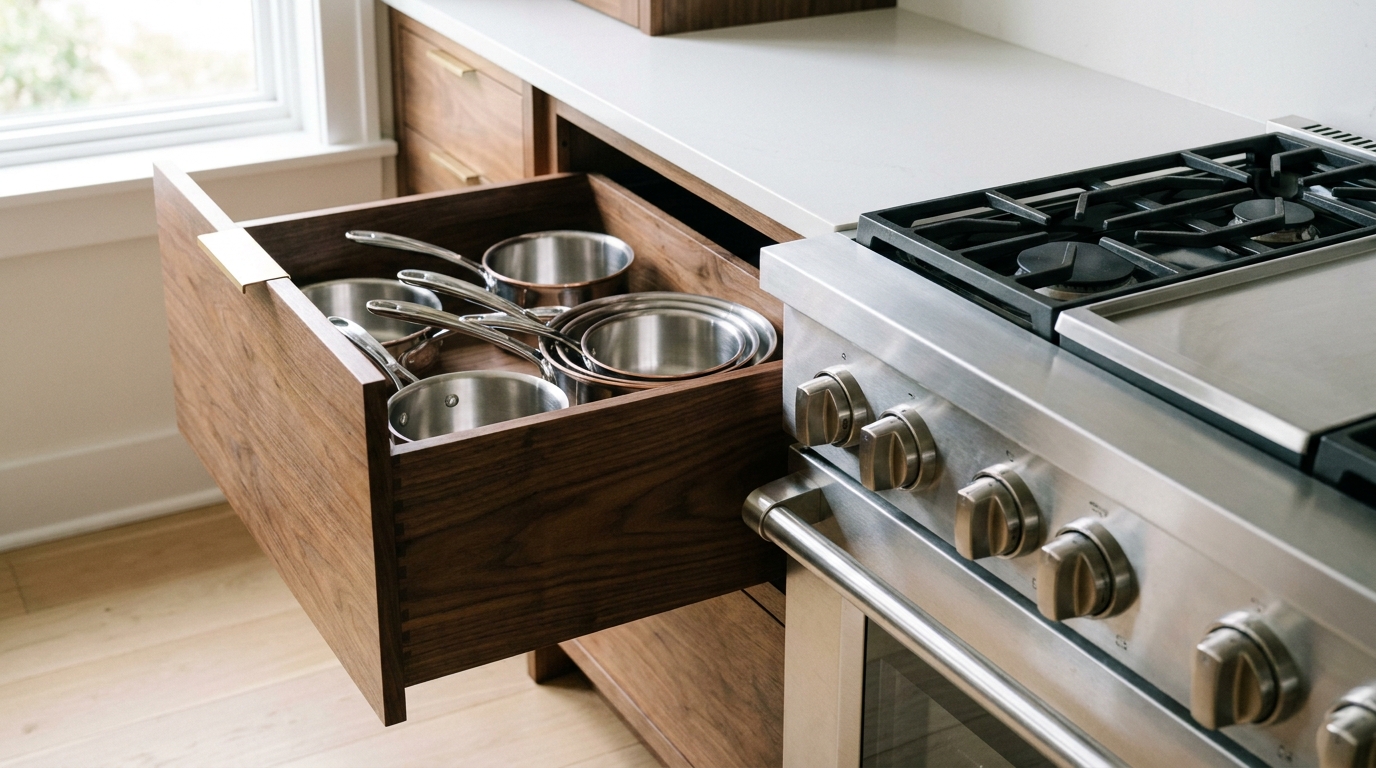
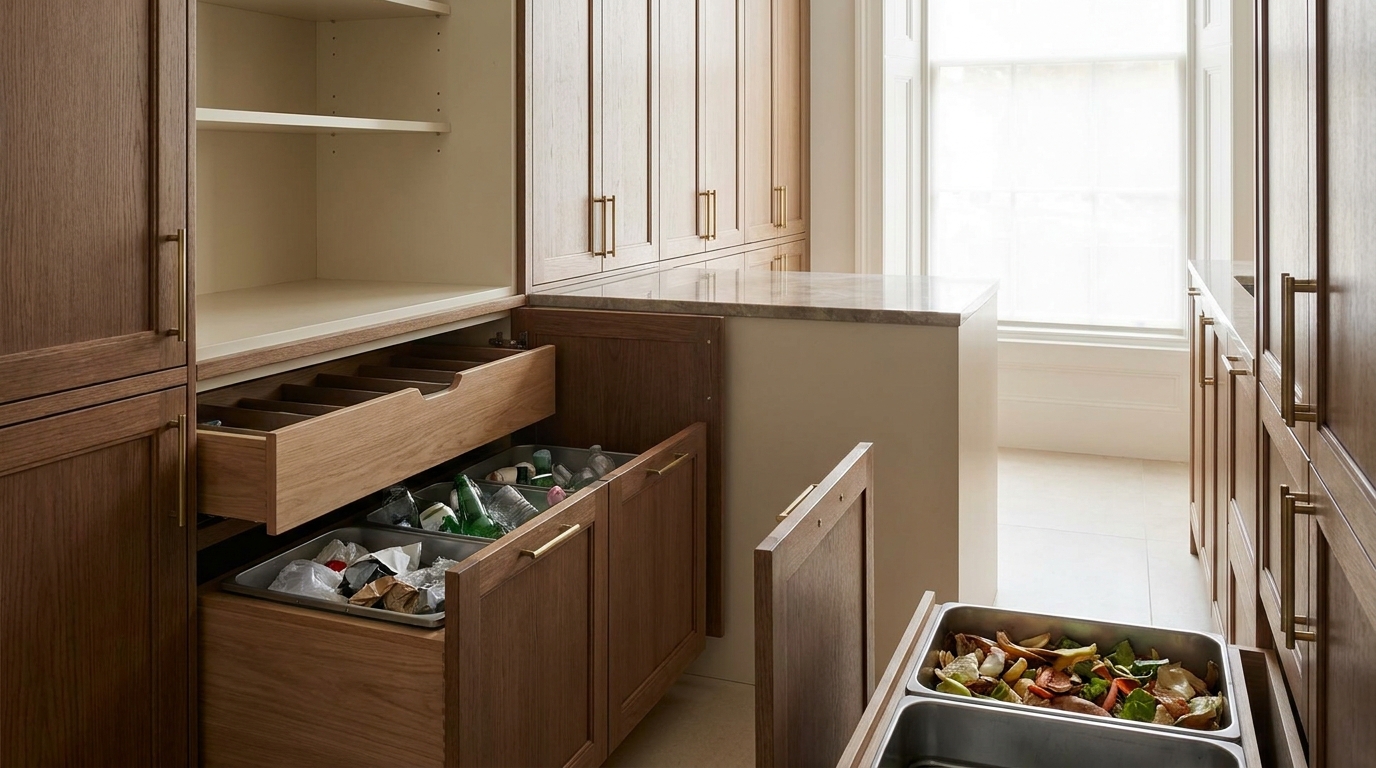
Beside the range, the bay serves the cook already standing there. The next sheet should be one step away, in a narrow file that does not steal landing space beside the cooktop. Inside the pantry, the same idea suits a kitchen whose base cabinets are full: sheets stand on edge, the cabinet stays cool and dry, and plastic boards do not press against the wall that shares a box with the oven.
We measure the bay with the rest of the kitchen. Our custom pantry work is planned around the food and tools a household uses, and a sheet-pan file belongs in that plan when you cook on pans. Home cooks in Charlotte NC, and in Fort Mill, Rock Hill, Ballantyne, Waxhaw, Wesley Chapel, and Indian Land, run into the same short cabinet run and a counter full of pans. We start with what you cook, measure in the home, and show a 3D view before anything is built, which is the sequence on our how it works page.
7. Set the slots before anyone builds them
- Name a job for each piece. Rimmed sheet, cookie sheet, raw-meat board, bread board, weeknight platter. No job, no easy slot.
- Retire boards you cannot get clean, including deep grooves and cracks [1][2]. Mark the raw board with color and a word on the divider [2].
- Measure the tallest piece and the depth it needs to stand. Add finger room. Do not copy someone else's inches.
- File dry pieces the same day. Wood needs air on both faces in a dry cabinet [1], not in the damp space under the sink.
Practical takeaways
- Store sheet pans, cutting boards, and platters on edge, with one visible face per slot, beside the range or in the pantry.
- Use one board for raw meat, poultry, and seafood and another for fresh produce [4]. Keep bread on the ready-to-eat board [1][2].
- After raw animal food, flood the board with 1 tablespoon of unscented bleach per gallon of water for several minutes, then rinse and dry [2][3]. On wood, use Maine's shorter contact times and do not soak the board [1].
- Dry boards upright, oil wood with food-safe mineral oil or beeswax about monthly, and replace any board with deep grooves [1][2].
- Wash a sheet that held raw meat before you set ready-to-eat food on it, the same way FDA says to wash a plate that held raw meat, poultry, seafood, or eggs [4]. Do not rinse the raw meat itself [5].
- Measure your own pieces. A slot that makes a heavy platter lean is the wrong slot.
How we can help
Have more questions or want to get in touch? Our team will look at the pans, boards, and platters you actually use, then design a vertical bay that clears the counter, either beside the range or in the pantry. Reach us through our contact page, call (704) 604-3870, or email design@theclosetrehab.com.
Citations
- University of Maine Cooperative Extension, "Bulletin #3108, Safe Cutting Boards: Materials, Usage, and Cleaning Tips" (2025)
- Academy of Nutrition and Dietetics, "Cutting Board Safety" (reviewed 2026-09-03)
- University of California Agriculture and Natural Resources, "Cutting Board Safety" (revised 2022-04)
- U.S. Food and Drug Administration, "Safe Food Handling" (2024-03-05)
- U.S. Food and Drug Administration, "Food Safety at Home" (2023-10-18)